

Vanguard Anti-Boost: What Gets Your Rank Removed
Riot shipped Vanguard Anti-Boost to VALORANT on September 17, 2026, after a year of private testing on League of Legends. This is what it detects, what it removes, and the line between a clean alternate account and a banned one.
Vanguard Anti-Boost is live on VALORANT. Riot moved its rank manipulation layer from League of Legends to its tactical shooter on September 17, 2026, and it does something a cheat detector never does: it deletes the rank you did not earn. It is Riot's second anti-cheat update of 2026, part of the same integrity push as Playing Fair and Playing with Respect. Here is what it detects, what it takes off your account, and the line between an alternate you leveled yourself and one that ends in a ban.
🎯 The short version
- Vanguard Anti-Boost is a classification layer, not a software detector. It reads ranked history, not your PC.
- It flags an account whose ranked points were earned by a higher-rated player logging into it.
- Sanctions hit the rank, not just the account: points and rewards are revoked, the account drops to its original rating, and a 3-day suspension lands on top.
- An account that was purchased or has no real owner gets banned "for one eternity." That is not the same punishment as a boosted account.
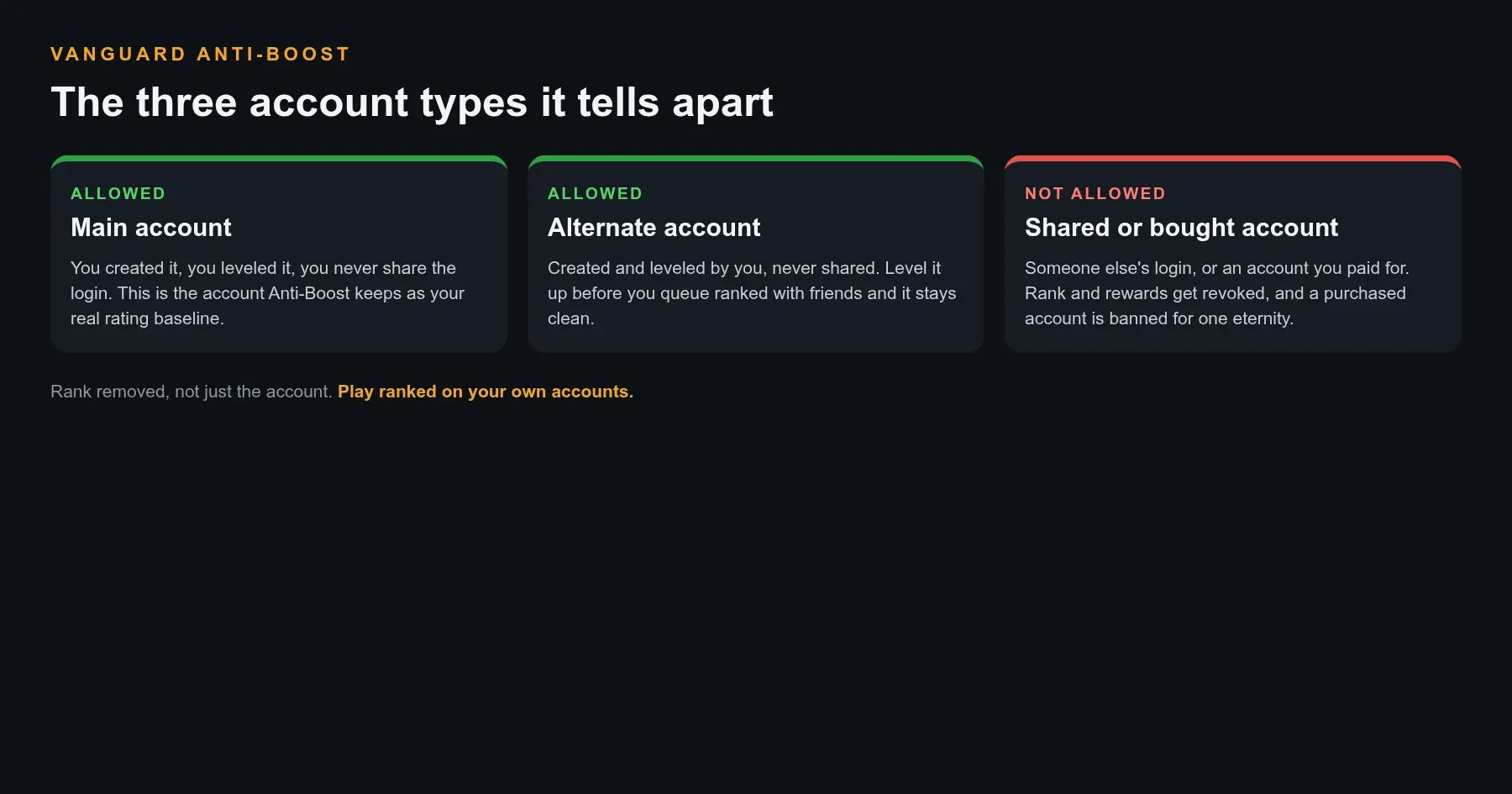
- Alternate accounts are still allowed. Riot says it explicitly. Sharing, buying, borrowing and tanking your rank are not.
- Riot has actioned 296,416 accounts for rank manipulation across VALORANT and League since late 2025, and the system is not at full power yet.

🔍 What Vanguard Anti-Boost checks
Anti-Boost is not an anti-cheat scanning for software. It is a classification layer inside Vanguard that looks at where an account's rating came from.
Riot's pattern is simple: an account stops playing in one place, reappears in another, and starts beating opponents far above its usual level. That signature is a higher-rated player on someone else's login, and Anti-Boost sorts it into three roles:
- Booster: the higher-rated player, or the paid service, doing the climbing on an account they do not own.
- Boostee: the account receiving rank it did not earn.
- Hitchhiker: the lower-rated player queued alongside the boostee for the free ride.
The system launched privately on League of Legends in September 2025. VALORANT then adopted it, and Riot says Anti-Boost's power doubled in the process.
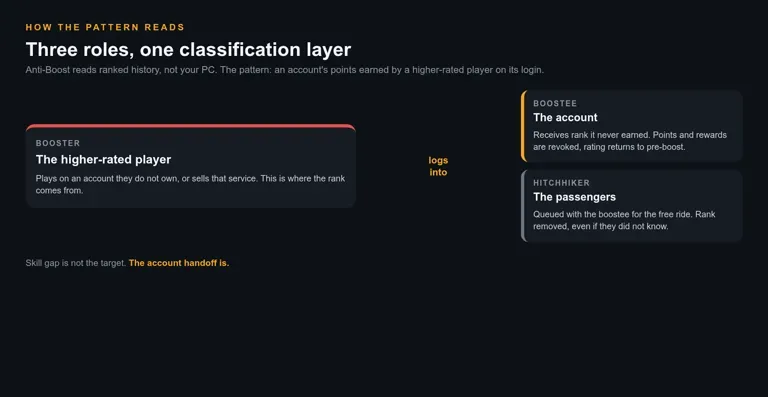
Queueing with friends at different ranks is still fine. Anti-Boost targets the account handoff, not the skill gap.
🚨 What it removes from your account
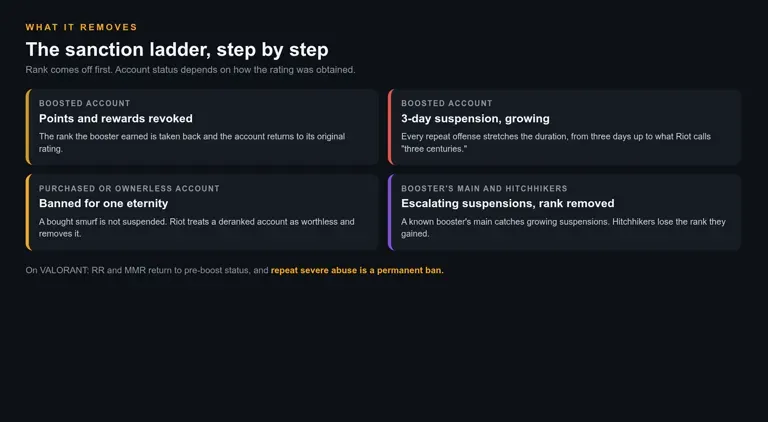
This is where rank manipulation stops being abstract and starts costing visible progress. When Anti-Boost confirms a boosted account, the ranked points and rewards the booster earned are revoked and the account returns to its original rating. A 3-day suspension comes with it, and each repeat offense stretches the duration, from three days all the way up to what Riot calls "three centuries."
The harsher case lands differently:
- An account that was purchased or had no real owner is banned "for one eternity" instead of suspended, because a deranked account has no value to the competitive ecosystem.
- A known booster with a main account catches escalating suspensions on that main as well.
- Hitchhikers lose the rank they gained, even when they did not know a boost was happening.
VALORANT's own version of that ladder, from the July 14 Playing Fair update, uses the same tools: RR and MMR returned to pre-boost status, removal of rewards tied to the manipulated rank, and permanent bans for repeated, severe abuse.
📊 The numbers behind the crackdown
Riot has actioned 296,416 accounts for rank manipulation across VALORANT and League of Legends since late 2025. The data underneath explains why:
- Around 9% of daily active ranked accounts are piloted by someone who is not on their main that day, including shared and stolen logins.
- Around 50% of secondary accounts are mostly harmless, which is exactly why Riot is not deleting every alternate.
- Over 70% of players own at least one alternate account, even if they do not touch it every month.
Read those three together and the strategy is obvious: Riot is not hunting alternates. It is hunting purchases and handoffs, where rank gets stolen.
✅ Allowed vs not allowed
Run your next queue through these two lists.
Allowed:
- Playing on an alternate account you created and leveled yourself.
- Five-stacking with friends, even when your ranks are far apart.
- Helping a newer friend learn the game.
- Having a bad game, or a bad act. Everyone bottom-frags sometimes.
Not allowed:
- Sharing an account.
- Purchasing an account.
- Borrowing an account.
- Stealing an account.
- Artificially lowering your rank by any means.
- Queuing with anyone doing one of the five above.
One rule prevents most accidents: level your alternate before you queue ranked with friends. Drag a fresh account into lobbies with a boosted pilot and it is your friend's rank that gets removed.
The behaviors that get you suspended
Riot published a non-exhaustive list. Six of the eight make the pattern obvious:
- Sharing your account with a boosting service.
- Paying boosters to queue with you on smurfs, even while you play on your own account.
- Giving a higher-rated friend a lower-rated account to queue with you on.
- Buying or borrowing a low-rated account to record frag footage for social media.
- Deliberately losing games to derank an account, especially if that account then boosts someone else.
- Bypassing a chat ban on your main by buying a new account.
MFA, TPM 2.0 and what comes next
Riot says to expect MFA restrictions and TPM 2.0 requirements on an expedited timeline, backed by Vanguard's hardware attestation, so the client can confirm it runs on real hardware piloted by a real person. Two things Riot has not attached to that plan: a date, and a rank. The wording is "stay tuned," and that is the entire timeline. Anything more specific is somebody's guess.
Vanguard Pre-Check already exists. It lets you get ahead of the requirement today, and Riot says 35% of players already satisfy its requirements through their existing hardware security settings.
🏆 What this changes on an Amber.gg ladder
Amber.gg runs its own ladders on player accounts, and that is the limit of our role. We do not sanction Riot accounts, we do not detect boosts, and we have no access to Riot's data. What Riot's enforcement buys you is a cleaner ranked pool to climb in, and that value follows you into every ladder you enter.
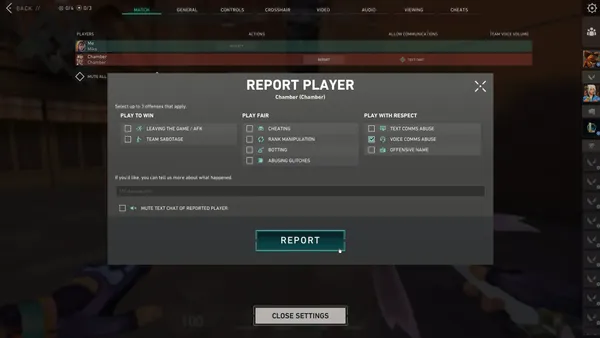
Spotted rank manipulation in a VALORANT match? The report category is Rank Manipulation, filed in game, and Riot says reporters now get feedback when an account is actioned. Our recap of the Patch 13.01 anti-boosting rollout shows where the detection started, and this no-smurfing prize pool format shows what clean competition looks like.
🧭 Your checklist before the next queue
- Rank on your own account. Every game, every lobby.
- Level your alternate before you queue ranked with friends.
- Never accept a login that is not yours, not even from a friend.
- Report rank manipulation with the Rank Manipulation category.
- Run Vanguard Pre-Check if you want to beat the MFA and TPM 2.0 timeline.
Clean accounts, fair lobbies, ranks that mean something. Play your ranked games on your own account and climb the VALORANT ladder on Amber.gg, or browse every ladder and tournament if you want to pick your game first.