

Esports Betting vs Skill-Based Competitions
Esports betting and skill-based competitions both ask for your money up front, but they pay out on very different things. Here is what each one does with it.
📉 Is esports betting worth it?
Esports betting means putting money on a result someone else produces: a team winning a series, a player topping the kill count, a map going to overtime. You can know the scene inside out and still have zero influence on what happens on stage.
That is the first problem. The second one is built into the price. Every bookmaker's odds include a margin, so even a perfectly informed bettor pays a fee on every bet. Over enough bets, that margin is what the bookmaker expects to keep.
So, is esports betting worth it? Some people treat it as entertainment paid for with money they can afford to lose. As a way to make money, the math works against you from the first bet.

How bookmakers make money on esports odds
The margin hidden in the price
Any price can be turned into an implied probability. In a fair book, the probabilities of every possible outcome add up to exactly 100%. Bookmakers price their markets so the total lands above 100%: that extra part is called the overround, and it represents the bookmaker's expected profit.
Picture a series between two evenly matched teams. Fair pricing gives each side 50%. Price each side at 52.5% instead and the book adds up to 105%. Whichever team wins, the payout is calculated on prices slightly worse than the real chances.
Margins vary from market to market. A study of six large bookmakers found that the average margin on Premier League football fell from 9% to 4% between the 2005/06 and 2017/18 seasons. Competition can shrink the margin, but it never disappears.
Combined bets multiply the margin
Combining several picks into one bet, an accumulator or parlay, does not dilute the margin. It compounds it: each pick carries its own overround, and they stack. Two picks with a margin around 9% each end up near 19% combined, roughly twice the cost of a single bet.
You never control the outcome
Analysis helps you read a matchup. It cannot stop a star player from having an off day, a roster swap the night before or a surprise draft. In betting, your money rides on other people's performance, and the price already includes the bookmaker's cut.
🎮 Skill-based competitions instead of betting
A skill-based competition flips the setup. You are not predicting what a pro team will do: you are the one playing, and your result comes from your own games.
A well-built competition works like this:
- You play your own matches, on your own account, in the game you already grind.
- The rules are the same for everyone and published before you enter.
- Results come from official game data, not from a judge or a random draw.
- Several matches count, so one unlucky solo queue game does not decide your result.
That last point matters. Even the best players get games with a teammate who disconnects. A format that scores a series of matches rewards sustained performance over a single bad game.
It is not risk-free. You can finish outside the paid places and lose your entry fee. The difference is what decides the outcome: your play, measured against players at your level.
⚖️ Esports betting vs skill: side by side
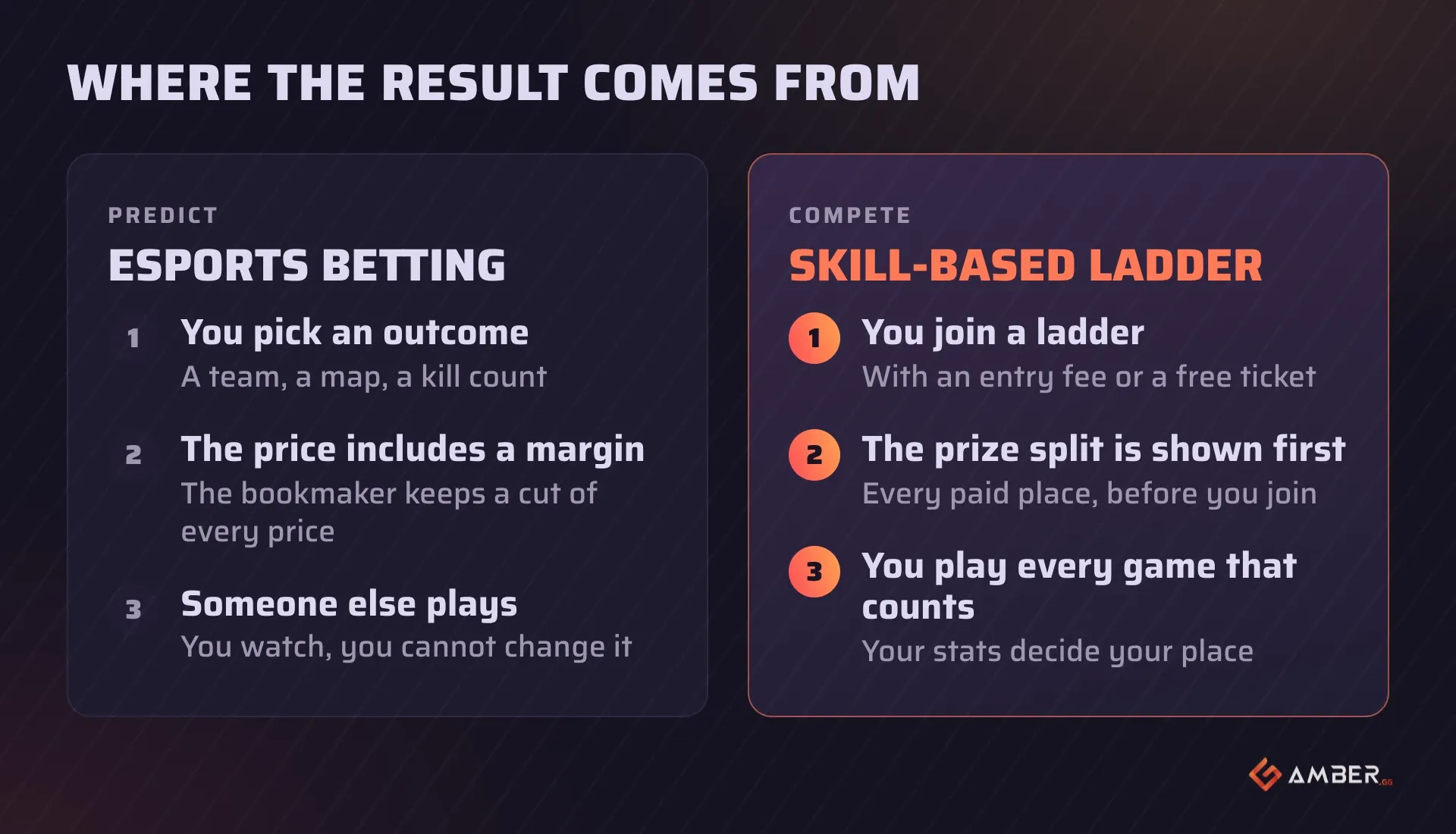
- Who decides the result: in esports betting, a team you are watching. In a skill-based competition, you.
- What you pay: in betting, a margin built into every price. In a skill-based competition, an entry fee, with the prize pool and payouts shown before you join.
- What improves your results: in betting, better information, against a price that already includes the margin. In a skill-based competition, getting better at the game.
- Who you face: in betting, the bookmaker's prices. In a rank-segmented competition, players in your own rank range.
- Combining picks: in betting, accumulators compound the margin. In a skill-based competition there is nothing to combine: you play your games.
🏆 How Amber.gg ladders work
Amber.gg runs skill-based ladders for League of Legends and Valorant. Here is the whole loop, from entry to withdrawal.
Free and paid ladders
Free ladders are entered with a ticket instead of cash, so you can learn the format before paying any entry fee. Paid ladders show their entry fee and prize structure before you join.
Rank ranges: you face players at your level
Ladders can be limited to a rank range, so a Silver player is not thrown into a field of Diamonds. You play the queue the ladder names, such as Ranked Solo/Duo in League of Legends or Competitive in Valorant, and your matches are scored from Riot's official game data, with the same rules for every entrant.

Includes Riot Games artwork.
What you see before you join
Before you join a paid ladder, you see its prize pool, how many places are paid and what each place pays out. The amounts shown assume a full ladder, so the final pool follows how many players actually enter. When the ladder ends, prizes go out by final rank, exactly as that distribution says.
There is no bookmaker on the other side of your entry, and no odds to beat. If a ladder starts without enough participants, it is canceled and every entry fee goes back to your wallet.
For the full picture of formats and prize pools, read the guide to how paid gaming competitions work. League players can go deeper with how to earn money playing League of Legends, and Valorant players with how to make money playing Valorant.
Getting paid
Cash winnings land in your wallet. To withdraw them:
- Withdrawals start at $30 and go up in whole steps of $10, within weekly and monthly limits that depend on your plan.
- A $1 processing fee is added on top, so a $30 withdrawal debits $31 from your balance and pays out $30.
- Identity verification is required before a payout is sent.
You must be 18 or over to use the platform, free ladders included, and paid entries are not available in every country: the terms of use explain where they apply.
Play responsibly
Whatever you choose, only spend money you can afford to lose. Set a budget before you start and stop when you reach it. If betting, or any competition for money, stops feeling like fun, free and confidential help is available:
- Anywhere in the world: Gambling Therapy, a free global support service run by Gordon Moody.
- United States: NCPG's helpline, by call or text at 1-800-MY-RESET (1-800-697-3738), or through its online chat.
- Great Britain: GambleAware, with free advice by phone or online chat, 24/7.
🚀 The esports betting alternative: compete on your own games
Esports betting asks you to predict. A skill-based competition asks you to play, against people at your rank, under rules you can read before you join. If you would rather compete than predict, find a ladder at your rank and start with a free one.