


How to Make Money Playing League of Legends in 2026
Ranked pays you in LP, not dollars. Here is every honest way to change that, what each route pays a normal player, and which shortcuts get an account banned.
You can make money playing League of Legends without being a pro, but every route pays in its own way and asks for a different kind of work. If you want to monetize your League of Legends skills in 2026, start by matching the route to the player you are. 🎯
Can you make money playing League of Legends? The short answer
Yes, you can earn money playing League of Legends, and you do not need a pro contract. Here is what each route asks from a normal player:
- Paid skill-based ladders: the closest thing to getting paid to play your usual games. Any rank, no team, no audience. You can win prizes in your first week, and you can also finish outside the paid places.
- Amateur and Riot circuits: team tournaments on a fixed schedule. Cash shows up mostly at the semi-pro level.
- Coaching: hourly income, but you need a high rank, teaching skills and students who come back.
- Streaming and content: the slowest route. Payouts start only after platform thresholds, and most channels take months to earn their first dollar.
- Going pro: a full-time job that very few players reach.

1. Play League of Legends for money in skill-based ladders 🏆
A ladder is a competition that runs over a set period, from a day to a month. You pay an entry, play your normal games, and the best performances over the period share the prize pool. You never queue into a special mode: the ladder reads the games you play in the regular client through your linked Riot account.
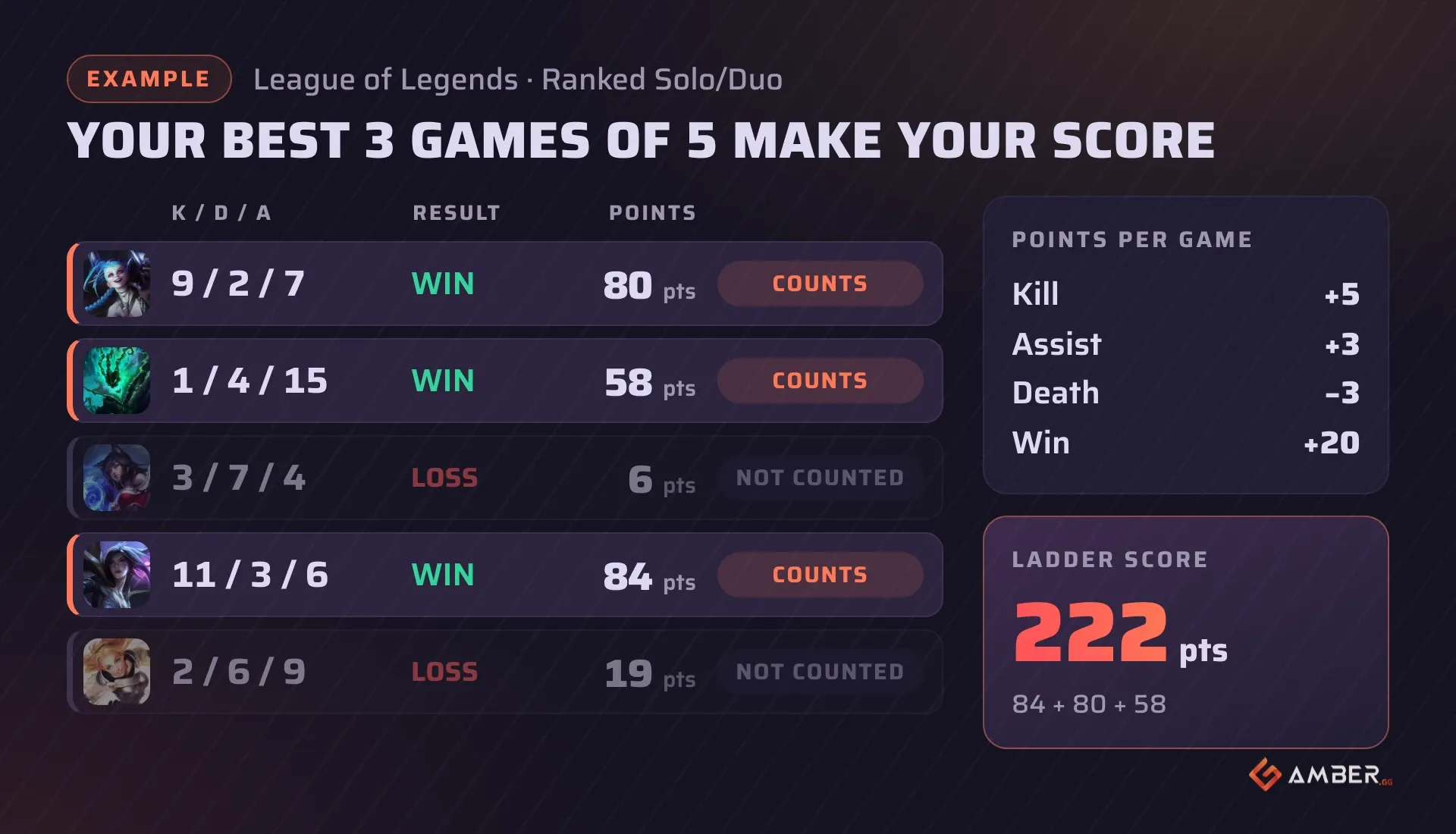
How a LoL ladder scores your games
- Queue: each ladder names its queue, usually Ranked Solo/Duo, and some use Flex, Normal Draft, ARAM or URF.
- Scoring: every game earns points from your stats, such as kills, deaths, assists, CS, vision score and the win.
- Best games count: a ladder caps the number of games, and only your best ones count toward your score. One bad game with an autofilled teammate does not sink your run.
- Prize table: each ladder shows how its prize pool is split between places before you enter.
Includes Riot Games artwork.
On Amber.gg, ladders open on a regular schedule, with cash entries and freeroll tickets that you earn by playing. A ticket ladder is the cheapest way to learn the format before you pay an entry.
What ladders really pay, and how you get paid
Be honest with yourself here: the prize pool comes from the entries, and some ladders add an organizer seed on top. Not every entrant gets paid. The amounts shown assume a full ladder: a ladder that fills halfway pays less, and one that misses its minimum number of players is canceled with every entry refunded. Read the prize table, count how many places it pays, and treat each entry as the price of a shot at those places. The players who earn over time are the ones who pick ladders that fit their queue, role and champion pool.
When you win, here is how the money leaves the platform:
- Withdrawals start at $30 and go up in whole steps of $10, up to $500 per request.
- A $1 fee is added on top: a $30 withdrawal takes $31 from your balance and pays you $30.
- Identity verification is required before you withdraw.
- Rolling 7-day and 30-day limits apply, and they depend on your plan.
New players also get a $5 welcome bonus in game credit once they deposit $20 or more. That credit pays ladder entries, it is not cash you can withdraw. For the full mechanics, from entries to prize pools, read how paid gaming competitions work.
You do not need to be Diamond to earn money in LoL
The biggest myth about earning money in League of Legends is that it belongs to Challengers. On a ladder, what matters is your performance against the other entrants over the cycle, not your place in the global ranking.
Skill is relative to the field
A ladder can set a rank range, checked when you join, so a Silver or Gold ladder is built for Silver or Gold players. Your goal is not to beat Diamonds. It is to play more consistently than the other entrants for a week. If you have ever climbed one tier, you have already shown you can do that, and the habits that win LP in ranked are the same ones that win a ladder.
Smurfs are the first worry for most players, and we cover that problem in how fair prize pool challenges are run in LoL.
Role ladders reward a sharp, narrow pool
Some ladders count only one role, or two, like bot lane. If you main support, you can enter a support ladder and compete against other supports. Games where you got autofilled into another role do not use up one of your counted games, so you can replay that slot.
A Silver support with hundreds of games on two enchanters is a real threat in that pool. Your champion pool does not need to be deep, it needs to be sharp inside your niche.
Check the meta before you enter
Before a ladder starts, run your mains through the LoL meta builds and tier list. A champion that struggles on the current patch drags your score down for the whole cycle, while a strong pick in your role gives you an edge from the first game. 📈
2. League of Legends tournaments for money: amateur and Riot circuits
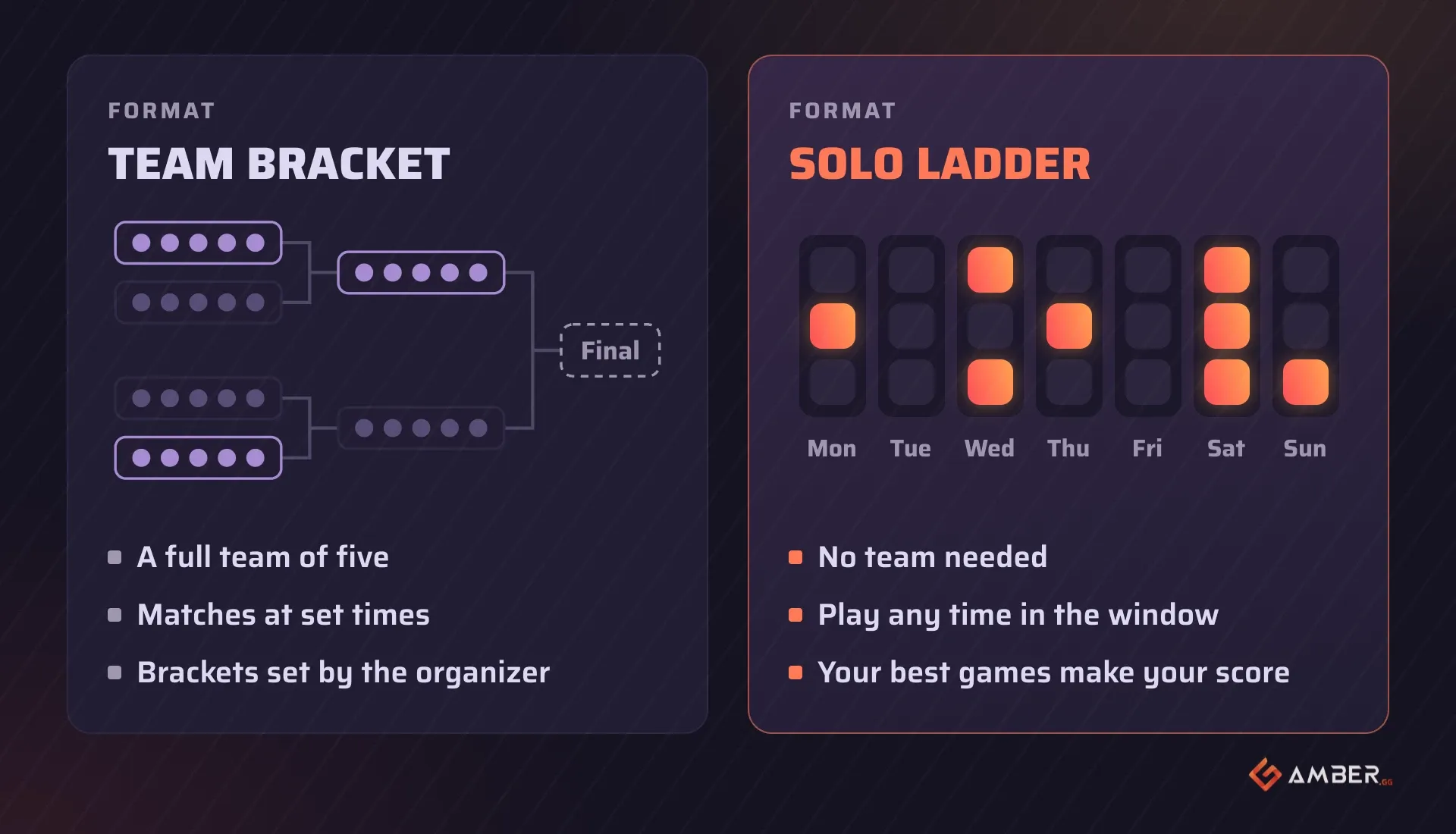
If you search for League of Legends cash tournaments, you will find two very different things: team tournaments with brackets and schedules, and solo ladders like the ones above. Our guide on how to join LoL tournaments with a prize pool explains the solo, async format. Here is where team play leads.
Clash: Riot's tournament, with no cash
Clash is Riot's monthly in-client tournament. You and four teammates each need a ticket, and you play single-elimination brackets on a weekend against teams near your skill level. Winners earn a trophy, every win gives Victory Points, and every entrant leaves with an orb or capsule. There is no cash prize: Clash is great practice for team play, not an income.
ERLs and the semi-pro path
In EMEA, the semi-pro scene runs through 13 Regional Leagues (ERLs) in 2026, including the Ligue Française de LoL, the Prime League, the Turkish Championship League and the Spain ERL. The best ERL teams meet at the EMEA Masters, held three times in 2026, and more than a dozen ERL players moved up to the LEC in 2025. Other regions have their own tiers below their top league.
This is the semi-pro level, and it asks for a full team, scheduled matches, scrims and tryouts. For most players, it is experience and visibility first, income second.
Community tournaments
Community organizers run team tournaments with prize pools, online and at LAN events. The money depends entirely on the organizer, and most of it goes to the top few teams. Check who runs the event, how prizes are paid and when, before you register a team.
3. Coaching: sell your League knowledge by the hour 🧠
Coaching pays for what you know, not for how many games you win. Students buy VOD reviews, live sessions and lane or macro lessons, so you need a high rank and the ability to explain why a play works.
Coaching marketplaces take a cut. On Metafy, coaches on the free Core plan pay 12% plus $1.79 per transaction since August 14, 2026, capped at 30% of their earnings, while the Pro plan costs $99 a month with no seller fee. On a $20 session under Core, that is $4.19 in fees and $15.81 for you.
Realistic picture:
- The first weeks are slow: reviews and returning students build your income, not your rank alone.
- Your schedule fills around your students: evenings and weekends, in their time zone.
- Never log into a student's account: playing on someone else's account counts as boosting under Riot's terms, even if you call it coaching.
4. Streaming and content creation 📺
Riot allows you to monetize League videos and streams: ads, donations, and subscriptions while you stream, as long as non-subscribers can still watch the games. Locking League content behind a paywall like Patreon outside of live streams needs a license from Riot.
The platforms set their own bars:
- Twitch: since its Monetization for All update, every streamer can receive Bits and subs, but you only get paid once you reach Affiliate or Partner. The Affiliate bar dropped in early June 2026 to 25 followers, 4 hours streamed, 4 stream days and an average of 3 viewers on 4 different days, all within 30 days. Payouts start at $50.
- YouTube: ad revenue through the Partner Program needs 1,000 subscribers plus either 4,000 watch hours in the last 12 months or 10 million Shorts views in the last 90 days.
A channel with a handful of viewers earns very little at first. Streaming pays the players who stay consistent for months and give viewers a reason to stay, like a ladder run with a live leaderboard. Treat it as a long game that you stack on top of another route.
5. Going pro: the long shot
Pro players earn salaries, prize money and sponsorships, but the road runs through years of high-elo play, an ERL or academy team, and then a top league. Only a small number of players worldwide reach a pro contract. If you are aiming for it, the ERLs above are your real starting point, and competing regularly in the meantime keeps your edge sharp.
What does not work, and what breaks Riot's terms 🚫
Some routes look like easy money and end with a banned account. Riot's Terms of Service, last updated December 1, 2024, rule out:
- Boosting: playing on another person's account, or any activity meant to boost an account's rank, is listed as cheating.
- Account sharing and selling: you cannot share your login, sell or transfer your account, or offer to.
- Selling virtual content for money: RP, skins and other virtual content cannot be redeemed for real-world money.
The penalties go from temporary bans to account termination, with no refund. Any offer that pays you to play on someone else's account breaks these rules.
Which route fits you?
- You want money tied to your own games, at any rank, without an audience: skill-based ladders.
- You have a team and free evenings: amateur circuits, with Clash for practice.
- You are high-ranked and like explaining the game: coaching.
- You enjoy talking while you play and can wait months: streaming and content.
Many players combine two of them, like streaming their ladder runs or coaching between cycles. If you also play Riot's tactical shooter, our guide on how to make money playing Valorant walks through the same routes for Valorant.
Start earning with your next ranked games
Link your Riot account, pick a ladder that fits your rank, role and queue on Amber.gg's League of Legends ladders, and turn the games you were going to play anyway into a shot at a prize pool. 🔥