Dialog content
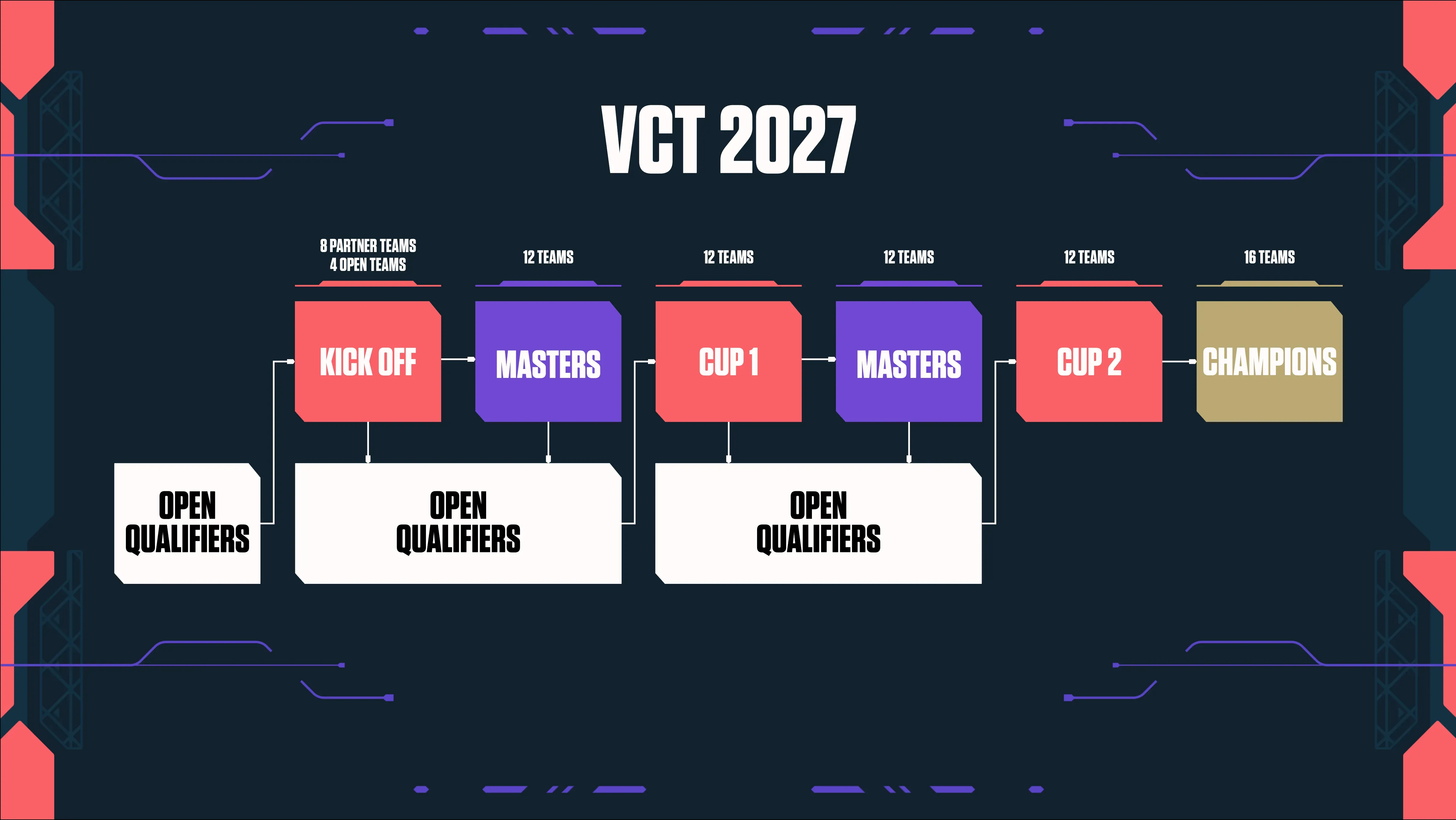
Riot Games just flipped VCT upside down. The VCT 2027 format ditches long-form stages and replaces them with a permanent tournament circuit where every single match has real stakes. Even franchise partner teams have to earn their place, match by match.
This isn't a minor adjustment. It's a full structural reset, and if you're following competitive Valorant on Amber.gg, here's everything you need to know.
The old VCT model ran on "Stages": extended league-style competition that rewarded consistent finishes. VCT 2027 eliminates that entirely. The new philosophy, in Riot's own words: "the best teams should earn their place every step of the way and every match matters."
That means no safe floors. No guaranteed qualification from week to week. Win or go home: from Kickoff to Champions, every bracket is do-or-die.
If you want context on how dominant teams have competed under the previous format, check out how Leviatán dismantled XLG at Masters London 2026: that's the caliber of play that will be required just to survive the new circuit.
© Riot Games / Valorant Esports
The 2027 season runs in three competitive cycles:
Each cycle's Open Qualifier runs concurrently with ongoing events, so teams that miss one window can immediately compete for the next slot. No waiting.
The Kickoff features a 12-team triple-elimination bracket per VCT territory (Americas, EMEA, Pacific). Composition:
The top 3 finishers from each territory's Kickoff advance directly to Masters 1. Partners get the seed, but no guaranteed placement beyond that.
Each of the four VCT territories (Americas, EMEA, Pacific, China) hosts 2 Cups per year, totaling 8 Cups globally. All Cups are LAN events held in rotating cities, not fixed VCT hubs. That's 20+ tournaments across 16+ cities in a single season 🌍.
Partner teams that underperform at Cups or Masters get pushed into Open Playoffs and must earn their way back in. No cushion, no safety net.
© Riot Games / Valorant Esports
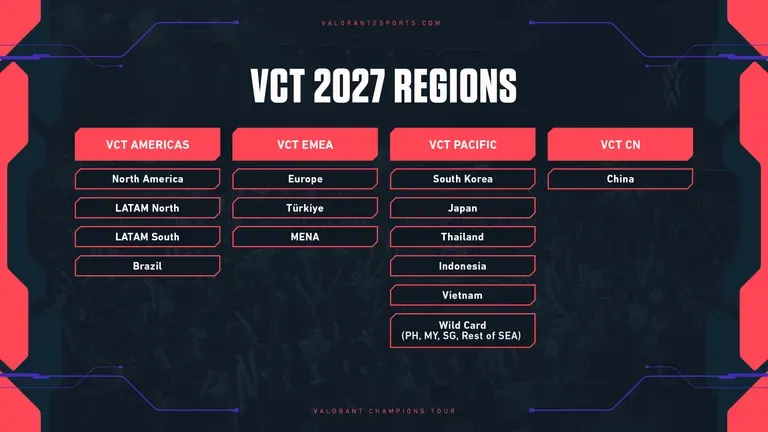
VCT 2027 expands to 14 competitive regions worldwide:
Thailand, Indonesia, and Vietnam each get their own dedicated zones for the first time. The Pacific territory also adds a Last Chance Qualifier specifically for South Asia and Oceania teams.
China maintains a distinct model with 8 partners, 2 visitor teams (with promotion/relegation), and 2 Open Qualifier slots.
This is a first in VCT history: guaranteed payouts tied to qualification results, plus travel aid on top.
The total annual prize pool exceeds $6,000,000 USD across all tournaments. In strong performance scenarios, a non-partner team could out-earn bottom-tier partner teams. 💵
There's also a roster continuity rule: non-partner teams that retain at least 3 of 5 starting players keep their accumulated points and qualification status throughout the season.
The two-tier system (franchised VCT + Ascension/Tier 2) is gone. Every team now competes in a single unified competitive tier from Open Qualifiers up to Champions. Any team, anywhere, can theoretically reach Masters or Champions without needing a promotion tournament.
For fans, that means more meaningful early-round matches and fewer "warm-up" weeks. For aspiring pros, it's the most open path to the top Valorant has ever offered.
You can follow the patch meta heading into VCT 2027 with our breakdown of VALORANT Patch 12.11, the last major balance update before Masters London playoffs.
Ready to prove your own skills? Jump into ranked Valorant ladders and compete for real stakes on Amber.gg 🎮.
Descubrir más
Puede que también te gusten estos artículos.